You started your HVAC company because you knew the industry.
Maybe you were a great technician.
Maybe you were an experienced service manager.
Maybe you saw an opportunity to build something better than the companies you’d worked for.
You hired your first employee, purchased another truck, started generating leads, and watched revenue grow.
But somewhere along the way, something changed.
Instead of running your business, your business started running you.
You’re answering calls after hours, solving dispatch problems, reviewing estimates, managing employees, checking payroll, handling customer complaints, and trying to figure out why revenue keeps increasing while your bank account doesn’t.
You’re working harder than ever.
Yet the company still depends on you to make almost every important decision.
This is where an experienced HVAC business coach can make a meaningful difference.
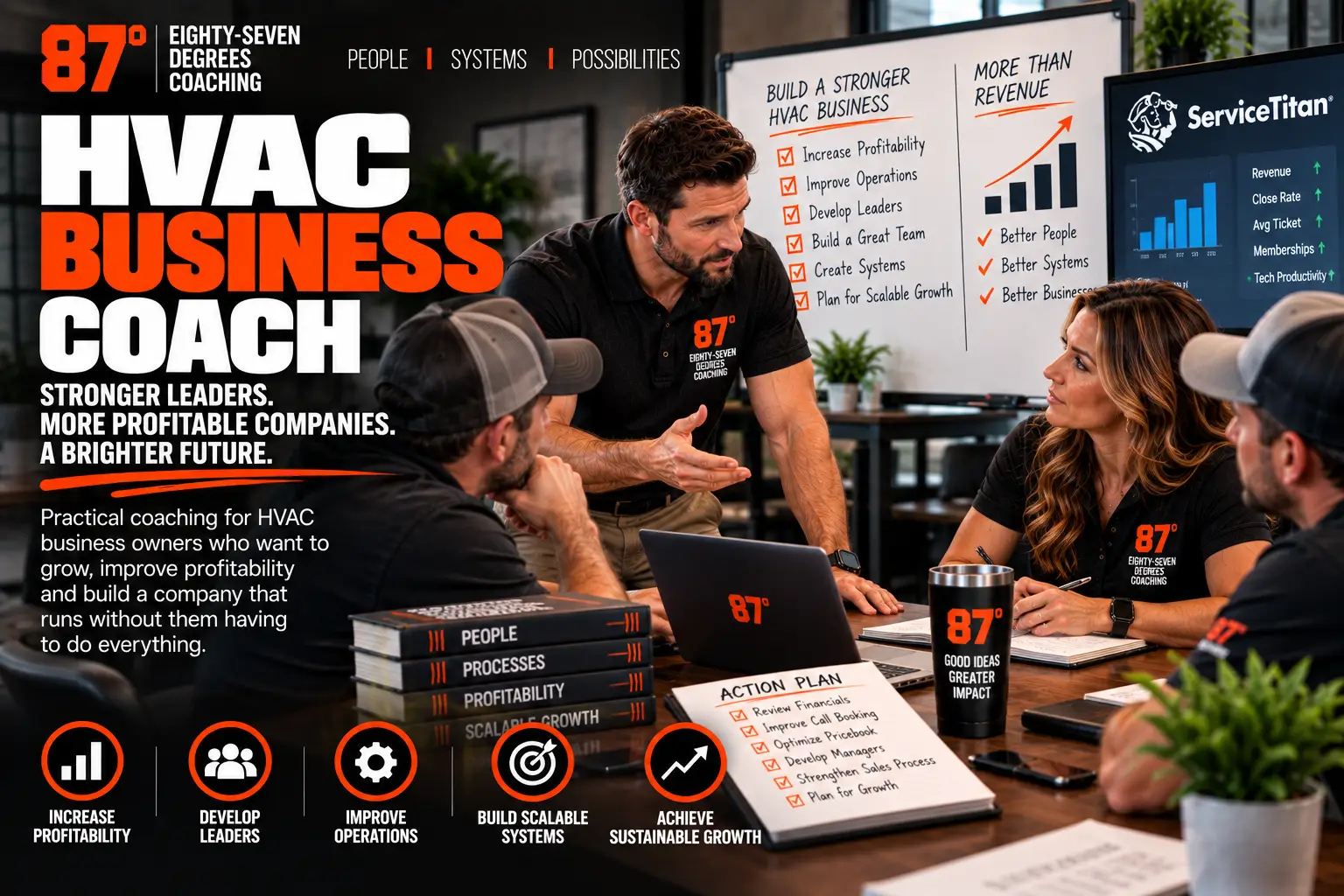
At Eighty-Seven Degrees Coaching, we help HVAC contractors develop stronger leadership, improve profitability, build accountable teams, and create the operational systems needed for sustainable growth.
Because the goal shouldn’t be to build a bigger job for yourself.
The goal should be to build a better business.
What Is an HVAC Business Coach?
An HVAC business coach works with heating and cooling business owners and their leadership teams to improve company performance through strategic planning, operational improvements, financial accountability, leadership development, and consistent execution.
Unlike a general business coach, an HVAC business coach should understand the specific challenges of operating a heating and cooling company.
That includes:
- Residential service and maintenance
- HVAC replacement sales
- Technician productivity
- Dispatching and scheduling
- Service agreement programs
- Flat-rate pricing
- Gross margin management
- Call center performance
- Recruiting and employee retention
- ServiceTitan reporting
- Leadership development
- Seasonal revenue fluctuations
An effective HVAC business coach doesn’t simply provide motivation or generic business advice.
They help owners identify what’s preventing the company from performing at its potential and establish practical systems to address those problems.
Why HVAC Business Owners Need Coaching
Most HVAC owners are highly capable people.
They understand their customers.
They know how to solve problems.
They’ve worked hard to build their companies.
But being an excellent technician or salesperson doesn’t automatically prepare someone to lead a growing organization.
The skills required to operate a $1 million HVAC company are different from those required to manage a $5 million, $10 million, or $20 million operation.
As the business grows, the owner’s responsibilities must evolve.
The Owner Becomes the Bottleneck
In smaller companies, the owner often handles everything.
They answer difficult customer questions.
Approve purchases.
Manage technicians.
Review estimates.
Make hiring decisions.
Handle pricing.
Solve scheduling problems.
That can work when the company is small.
But as revenue grows, the owner becomes the person everyone waits on.
Instead of building systems, the business becomes dependent on one individual.
Revenue Growth Hides Operational Problems
A growing HVAC company can appear successful while developing serious financial and operational weaknesses.
More trucks create more revenue.
But they also create more payroll, insurance, fuel, equipment, management, and administrative expenses.
Without strong financial controls, increased revenue doesn’t necessarily produce increased profit.
An HVAC business coach helps leadership understand the difference between growth and profitable growth.
1. An HVAC Business Coach Helps You Understand Your Numbers
One of the first things an experienced coach should evaluate is financial performance.
Many contractors know their monthly revenue.
Far fewer consistently understand the operational and financial metrics driving that revenue.
For example, an owner may say:
“We did $4 million last year.”
That’s useful information.
But it doesn’t answer the most important questions.
How much gross profit did the company generate?
What was the operating profit?
Which departments performed well?
Which services produced weak margins?
How much revenue did each technician generate?
What did it cost to acquire customers?
Where did the company lose money?
Revenue Isn’t the Same as Profit
Imagine two HVAC companies.
Company A
- Annual revenue: $5 million
- Operating profit margin: 4%
- Operating profit: $200,000
Company B
- Annual revenue: $4 million
- Operating profit margin: 12%
- Operating profit: $480,000
These are hypothetical examples, but they illustrate an important point.
The larger company isn’t necessarily the stronger business.
An HVAC business coach helps owners focus on profitability, cash flow, and operational performance rather than celebrating revenue alone.
Identify the KPIs That Actually Matter
Depending on the business model, useful KPIs may include:
- Gross margin by department
- Revenue per technician
- Average service ticket
- Call booking rate
- Technician utilization
- Replacement close rate
- Revenue per opportunity
- Membership retention
- Callback rate
- Labor efficiency
- Marketing cost per booked job
The objective isn’t to overwhelm managers with dozens of reports.
It’s to establish a focused scorecard that helps leadership make better decisions.
2. Improve HVAC Pricing and Gross Margins
One of the most common profitability challenges in HVAC is pricing.
Many contractors set prices based on competitors.
Others use outdated labor assumptions.
Some apply a standard markup without fully understanding the gross margin it produces.
And some discount aggressively because they’re afraid of losing the job.
These habits can undermine profitability.
Understand Your True Costs
Effective HVAC pricing should account for relevant expenses, including:
- Direct labor
- Payroll burden
- Materials
- Equipment
- Vehicle expenses
- Overhead
- Warranty exposure
- Target profit
A coach can help leadership evaluate whether the current pricing structure supports the company’s financial goals.
Review Your Pricebook
An outdated or disorganized pricebook can create inconsistent estimates, technician confusion, and margin problems.
A structured review should examine pricing assumptions, service categories, descriptions, discount controls, and maintenance procedures.
If your company uses ServiceTitan, pricebook optimization can become an important part of the broader operational improvement process.
Stop Using Discounts as a Sales Strategy
Discounting can sometimes be appropriate.
But when every difficult customer conversation ends with a lower price, the company may have a sales training problem rather than a pricing problem.
A business coach can help leadership evaluate both.
3. Build an HVAC Company That Doesn’t Depend on the Owner
This may be one of the most important reasons to hire an HVAC business coach.
You cannot scale indefinitely if every decision requires your approval.
At some point, the company needs a management structure.
That means defining responsibilities, establishing processes, and developing leaders who can make appropriate decisions independently.
Move From Doing to Leading
In the early stages, the owner is often the best technician, salesperson, dispatcher, and problem solver.
As the company grows, that approach becomes increasingly difficult to sustain.
The owner’s role should gradually shift toward:
- Strategic planning
- Leadership development
- Financial oversight
- Performance management
- Recruiting key personnel
- Establishing company priorities
- Building long-term business value
That transition doesn’t happen automatically.
It requires intentional development.
Create Clear Accountability
Every major function should have an owner.
Who is responsible for call booking performance?
Who manages technician productivity?
Who reviews unsold estimates?
Who owns membership retention?
Who monitors gross margin?
If the answer to every question is the business owner, the management structure needs attention.
An HVAC business coach helps clarify responsibilities and establish accountability.
4. Improve Technician Productivity Without Burning Out Your Team
Technicians are essential to HVAC company performance.
But productivity isn’t simply about asking technicians to run more calls.
A technician can work an exhausting day while producing disappointing financial results because of poor scheduling, excessive drive time, missing materials, or inefficient processes.
Evaluate Revenue Per Technician
Revenue per technician can be a useful performance indicator when interpreted alongside job mix, labor hours, margins, and service quality.
A coach may help management evaluate:
- Completed jobs
- Average ticket
- Billable hours
- Drive time
- Callback frequency
- Estimate presentation
- Membership opportunities
- Revenue and gross profit
The objective is to understand performance rather than simply demanding more production.
Fix Operational Obstacles
If technicians consistently lose time because dispatch sends them across town, that’s a management problem.
If trucks lack commonly used materials, that’s a process problem.
If technicians don’t understand the pricebook, that’s a training problem.
Coaching helps leadership identify the root causes behind weak productivity.
5. Develop a Stronger HVAC Sales Team
HVAC replacement sales can represent a significant source of revenue.
But many contractors rely too heavily on one or two high-performing salespeople.
Those individuals may produce excellent results.
However, the company becomes vulnerable when sales success depends entirely on their personalities or experience.
Build a Repeatable Sales Process
A structured HVAC sales process should include:
- Appointment preparation
- Customer discovery
- Home evaluation
- Identifying homeowner priorities
- Presenting appropriate solutions
- Explaining options
- Discussing investment and financing
- Addressing customer concerns
- Asking for the business
- Following up with unsold estimates
The process should be documented, taught, practiced, and coached.
Coach Salespeople Consistently
An occasional sales meeting isn’t enough.
Managers should regularly review performance, practice difficult conversations, and provide specific feedback.
That’s the philosophy behind the Eighty-Seven Degrees Coaching Comfort Consultant Program.
The six-week, manager-led training structure helps contractors develop Comfort Consultants through repeatable processes, role-play exercises, objection handling, and ongoing coaching.
The goal is to build a stronger sales organization rather than depending on one superstar salesperson.
6. Improve HVAC Call Center and Booking Performance
Your marketing can generate hundreds of leads.
But if your call center fails to convert those opportunities into appointments, your company loses potential revenue before a technician ever reaches the home.
Track Call Booking Rate
A business coach may evaluate:
- Incoming call volume
- Qualified booking opportunities
- Booking rate
- Missed calls
- Call handling procedures
- Appointment confirmation processes
- Customer communication quality
These metrics can reveal opportunities to improve performance without increasing advertising spending.
Train CSRs on More Than Scripts
Scripts can provide structure.
But CSRs also need to understand how to listen, ask relevant questions, communicate clearly, and navigate common customer concerns.
Training should include realistic scenarios and ongoing feedback.
Review Calls Regularly
Managers should evaluate actual customer interactions, identify recurring problems, and coach employees.
A strong call center process creates consistency while allowing employees to communicate naturally.
7. Optimize Dispatching and Scheduling
Poor dispatching can quietly reduce profitability.
Consider what happens when:
- Technicians drive unnecessarily long distances
- Jobs are assigned without considering skills
- Appointment windows are unrealistic
- High-priority calls are mishandled
- Scheduling gaps create idle time
- Customers receive inconsistent arrival information
Each problem affects efficiency and customer satisfaction.
Create Dispatch Priorities
An HVAC business coach can help leadership define scheduling principles that reflect the company’s operating model.
That may involve balancing geography, technician skills, appointment urgency, maintenance obligations, and revenue opportunities.
Measure Dispatch Performance
Useful indicators may include:
- Technician utilization
- Completed calls per day
- Drive time
- Schedule adherence
- Callback frequency
- Customer rescheduling
- Capacity utilization
The goal is a dispatch process that supports technicians, customers, and profitability.
8. Strengthen HVAC Maintenance Membership Programs
Maintenance agreements can support recurring customer relationships, seasonal scheduling, and future service opportunities.
But a membership program needs to be managed carefully.
Selling more agreements isn’t enough.
The company must also fulfill the promised services efficiently and understand the program’s financial performance.
Evaluate Membership Health
A coach may help review:
- New memberships sold
- Renewal rate
- Cancellation rate
- Maintenance completion
- Membership revenue
- Fulfillment costs
- Customer retention
- Opportunities generated through maintenance visits
Build Consistent Membership Processes
Technicians and CSRs should understand how the program works, when to explain it, and how to communicate its benefits accurately.
Managers should also establish processes for scheduling, renewals, and customer communication.
A strong membership program should support customer relationships and long-term business performance.
9. Use ServiceTitan to Manage the Business More Effectively
Many HVAC contractors invest in sophisticated software but struggle to use it consistently.
ServiceTitan can support scheduling, dispatching, estimates, invoicing, reporting, and other operational functions.
However, the platform’s value depends on accurate data and consistent workflows.
Software Doesn’t Replace Management
A dashboard can show declining booking rates.
But a manager still needs to investigate the cause.
A report can reveal low technician productivity.
But leadership must determine whether the issue involves scheduling, training, job mix, or another factor.
An HVAC business coach helps connect technology to management action.
Improve Reporting and Accountability
As a ServiceTitan Certified Partner, Eighty-Seven Degrees Coaching helps contractors evaluate how their software workflows support operational objectives.
This may involve reviewing:
- Business unit organization
- KPI dashboards
- Pricebook structure
- Technician workflows
- Estimate tracking
- Sales reporting
- Employee adoption
- Management review processes
Learn more about the platform at ServiceTitan.
The objective is to turn business information into better decisions.
10. Develop HVAC Managers Into Leaders
One of the biggest obstacles to growth is a lack of management development.
An owner promotes a great technician into a service manager position.
Or promotes the top salesperson into sales management.
Then expects them to lead people effectively without training.
Technical ability and leadership ability are different skills.
Managers Need a Defined Role
A service manager should understand their responsibilities for technician development, operational performance, customer experience, and accountability.
A sales manager should understand coaching, pipeline management, sales KPIs, and team development.
A general manager should understand how departments connect to financial performance and company priorities.
Teach Managers How to Coach
Effective managers don’t simply tell employees what went wrong.
They identify behaviors, provide feedback, establish expectations, and follow up.
An HVAC business coach can help managers develop those skills.
Build a Leadership Rhythm
Consistent management meetings can help the company stay focused.
A practical rhythm might include:
Daily: Review operational priorities and immediate obstacles.
Weekly: Review KPIs, employee performance, and corrective actions.
Monthly: Evaluate financial results and departmental trends.
Quarterly: Review strategic priorities, staffing, and growth plans.
The schedule should fit the business.
Consistency matters more than creating unnecessary meetings.
11. Build Standard Operating Procedures That Employees Actually Use
Many contractors believe they have documented processes.
But the procedures are scattered across emails, outdated manuals, and the owner’s memory.
That’s not a reliable operating system.
Start With Critical Workflows
Prioritize processes that affect customer experience, revenue, and profitability.
Examples include:
- Answering incoming calls
- Booking appointments
- Dispatching technicians
- Completing service jobs
- Presenting estimates
- Collecting payment
- Following up with customers
- Managing callbacks
- Handling complaints
- Onboarding employees
Keep SOPs Practical
A 40-page document that nobody reads isn’t necessarily better than a concise checklist employees actually follow.
The best SOPs are clear, accessible, and supported by training.
Assign Process Ownership
Someone should be responsible for maintaining each critical procedure.
As the company changes, its operating procedures should evolve.
12. Improve Recruiting, Training, and Employee Retention
Growth requires people.
But hiring more employees without a strong onboarding and management process can create additional problems.
An HVAC business coach can help leadership evaluate how the company recruits, develops, and retains employees.
Create Role Expectations
Employees should understand what success looks like.
A technician needs clear expectations for workmanship, customer communication, documentation, and job completion.
A CSR needs clear booking and communication standards.
A manager needs defined performance responsibilities.
Build Structured Onboarding
New hires shouldn’t be expected to figure everything out through trial and error.
A structured onboarding process may include:
- Company expectations
- Job-specific procedures
- Software training
- Customer communication standards
- Safety requirements
- Performance expectations
- Manager check-ins
Develop Employees Before They Become Managers
Leadership development should begin before a promotion.
Identify employees with management potential and provide opportunities to develop communication, problem-solving, and coaching skills.
13. Create an HVAC Growth Strategy Based on Capacity and Profitability
Growth sounds exciting.
More trucks.
More technicians.
Another location.
A larger building.
More advertising.
But growth without planning can strain cash flow and management capacity.
Ask the Right Questions Before Expanding
Before adding another truck, evaluate:
- Is there enough demand?
- Can the company recruit qualified employees?
- Is dispatch prepared?
- Can management support additional technicians?
- Is working capital sufficient?
- Are existing departments profitable?
- Will expansion improve overall financial performance?
Don’t Expand to Escape Existing Problems
If your current operation struggles with poor margins, weak accountability, or inconsistent reporting, expansion may magnify those issues.
An HVAC business coach helps leadership determine whether the company is operationally prepared for growth.
HVAC Business Coach vs. HVAC Business Consultant: What’s the Difference?
The terms are often used interchangeably, but they can describe different types of support.
HVAC Business Coaching
Typically emphasizes ongoing leadership development, accountability, strategic decision-making, and management performance.
HVAC Business Consulting
Often focuses on diagnosing specific operational problems and implementing targeted improvements.
For example, a consultant may help redesign a pricebook or optimize a dispatch workflow.
A coach may work with the owner and managers over time to strengthen leadership and accountability.
In practice, many HVAC companies benefit from both.
That’s why Eighty-Seven Degrees Coaching combines operational consulting with leadership and business coaching.
How Much Does an HVAC Business Coach Cost?
HVAC business coaching costs vary depending on the provider, scope, company size, and level of involvement.
Some programs provide group coaching and educational resources.
Others offer individualized sessions, operational assessments, leadership development, and implementation support.
When evaluating the cost, consider what the engagement includes.
Will the coach review your financial performance?
Help establish KPIs?
Work with your managers?
Evaluate operational processes?
Provide accountability?
Help implement improvements?
The lowest-priced program isn’t necessarily the best value.
The right fit depends on the company’s challenges and the type of support needed.
How to Choose the Right HVAC Business Coach
Not every business coach understands the HVAC industry.
Before hiring someone, ask several important questions.
Do They Have Real HVAC Industry Experience?
Generic business principles can be useful.
But home service companies face specific operational challenges involving dispatching, technician productivity, replacement sales, seasonality, and pricing.
Industry experience matters.
Have They Helped Build or Manage a Growing Business?
Look for practical experience with the challenges your company faces.
Understanding how growth affects staffing, cash flow, management, and operational complexity is important.
Do They Focus on Profitability?
Be cautious of programs that focus almost entirely on revenue growth.
A strong coach should understand margins, operating expenses, and financial performance.
Will They Work With Your Leadership Team?
Improving the owner’s decision-making is valuable.
But developing managers can create more lasting operational improvements.
Do They Provide Accountability?
Good ideas aren’t enough.
A coaching relationship should establish priorities, responsibilities, and follow-through.
Signs Your HVAC Company Could Benefit From Business Coaching
You may benefit from an HVAC business coach if:
- Revenue is growing, but profitability isn’t.
- You work excessive hours and struggle to delegate.
- Managers constantly depend on you for decisions.
- Your KPIs are unclear or unreliable.
- Technician productivity varies significantly.
- Your sales team lacks a repeatable process.
- Employee turnover creates recurring operational problems.
- Your pricebook hasn’t been reviewed recently.
- You’re considering expansion but aren’t confident in your systems.
- You feel like the business cannot operate without you.
These challenges are common as companies grow.
The important question is whether you have a plan to address them.
What Should the First 90 Days With an HVAC Business Coach Look Like?
Every company has different needs, but a structured coaching engagement should establish clear priorities early.
Days 1–30: Assess the Business
Begin by understanding the current operation.
Review:
- Financial performance
- Organizational structure
- Departmental KPIs
- Pricing practices
- Sales processes
- Dispatch operations
- Technician productivity
- Management accountability
Identify the most significant obstacles to profitability and growth.
Days 31–60: Implement Priority Improvements
Focus on a manageable number of high-impact changes.
These might include:
- Establishing weekly KPI reviews
- Correcting reporting problems
- Improving pricebook controls
- Creating manager accountability
- Standardizing sales follow-up
- Improving call center coaching
Avoid attempting to overhaul every department simultaneously.
Days 61–90: Measure and Refine
Review whether the changes are working.
Are managers following the new processes?
Has reporting improved?
Are employees meeting expectations?
Are operational problems becoming easier to identify?
Use the results to establish the next set of priorities.
The goal isn’t to transform the entire company in 90 days.
It’s to create meaningful progress and a sustainable improvement process.
Why Choose Eighty-Seven Degrees Coaching as Your HVAC Business Coach?
Eighty-Seven Degrees Coaching was built around the real challenges HVAC and home service business owners face.
Founder Jason Arthur brings nearly 20 years of industry experience, including helping grow a consumer division from just over $2 million to more than $20 million.
That experience informs a practical approach to business improvement.
We understand that HVAC owners don’t need another motivational speech.
They need better systems, stronger managers, reliable numbers, and a clear path forward.
Our coaching and consulting services focus on:
Profitability and Financial Performance
Understanding the numbers that drive sustainable business success.
Leadership Development
Helping owners and managers become more effective leaders.
Operational Efficiency
Improving workflows, productivity, and accountability.
ServiceTitan Consulting
Connecting software utilization with operational performance.
Sales Coaching
Developing repeatable sales systems and stronger Comfort Consultants.
Sustainable Growth
Building a business that can expand without creating unnecessary dependence on the owner.
Our philosophy is simple: Better people. Stronger systems. Better businesses.
Frequently Asked Questions About HVAC Business Coaching
Is an HVAC business coach worth it?
An HVAC business coach can be valuable when the engagement addresses meaningful business challenges and leads to measurable improvements. The potential value depends on the company’s needs, the coach’s experience, and the owner’s willingness to implement changes.
Can an HVAC business coach help a small company?
Yes. Smaller HVAC companies can benefit from establishing financial controls, pricing discipline, documented processes, and leadership habits before rapid growth creates additional complexity.
Can HVAC business coaching improve profitability?
Coaching may help identify opportunities involving pricing, gross margin, labor efficiency, technician productivity, sales performance, and overhead. Results depend on the changes implemented and the company’s circumstances.
Does HVAC business coaching include ServiceTitan consulting?
Some coaching providers offer software consulting, while others focus exclusively on leadership or business strategy. Eighty-Seven Degrees Coaching provides ServiceTitan-related consulting alongside broader operational and leadership development.
How long does HVAC business coaching take?
That depends on the company’s objectives. Some operational improvements can be implemented relatively quickly, while leadership development and organizational change often require ongoing work.
What’s the difference between HVAC sales coaching and business coaching?
HVAC sales coaching focuses primarily on sales behaviors, customer conversations, closing performance, and sales management. HVAC business coaching addresses broader areas such as profitability, operations, leadership, staffing, and company strategy.
Can a business coach help me step away from daily operations?
A coach can help establish management responsibilities, standard operating procedures, reporting systems, and accountability structures that reduce unnecessary owner involvement. The degree of owner independence depends on the company’s leadership capacity and implementation.
Stop Being the Hardest-Working Employee in Your HVAC Company
Building an HVAC business takes dedication.
But working harder isn’t always the answer.
At some point, sustainable growth requires better systems, stronger leadership, and more consistent management.
You need to know your numbers.
You need managers who can make decisions.
You need employees who understand expectations.
You need a repeatable sales process.
And you need an operation that doesn’t depend on you personally solving every problem.
That’s what effective HVAC business coaching should help you build.
At Eighty-Seven Degrees Coaching, we work with contractors who want to improve profitability, strengthen their teams, and create businesses capable of sustainable growth.
Whether you’re trying to move beyond the owner-operator stage, improve a growing HVAC company, or prepare for your next phase of expansion, the right coaching relationship can help you identify what needs to change and establish a plan to make it happen.
Ready to build a stronger HVAC business?
Contact Eighty-Seven Degrees Coaching to discuss your business goals, operational challenges, and opportunities for improvement.
Build a company that works because of your systems, not because you have to do everything yourself.