
Roofing companies can grow fast.
A major storm hits. Leads pour in. Salespeople are running appointments. Crews are booked. Revenue climbs. Everyone is working at full speed.
Then the market changes.
Lead volume slows. Competition increases. Margins tighten. Salespeople who looked great during peak demand suddenly struggle. Production problems surface. Cash flow becomes harder to manage.
That’s when roofing contractors discover the difference between having a busy roofing company and having a strong roofing business.
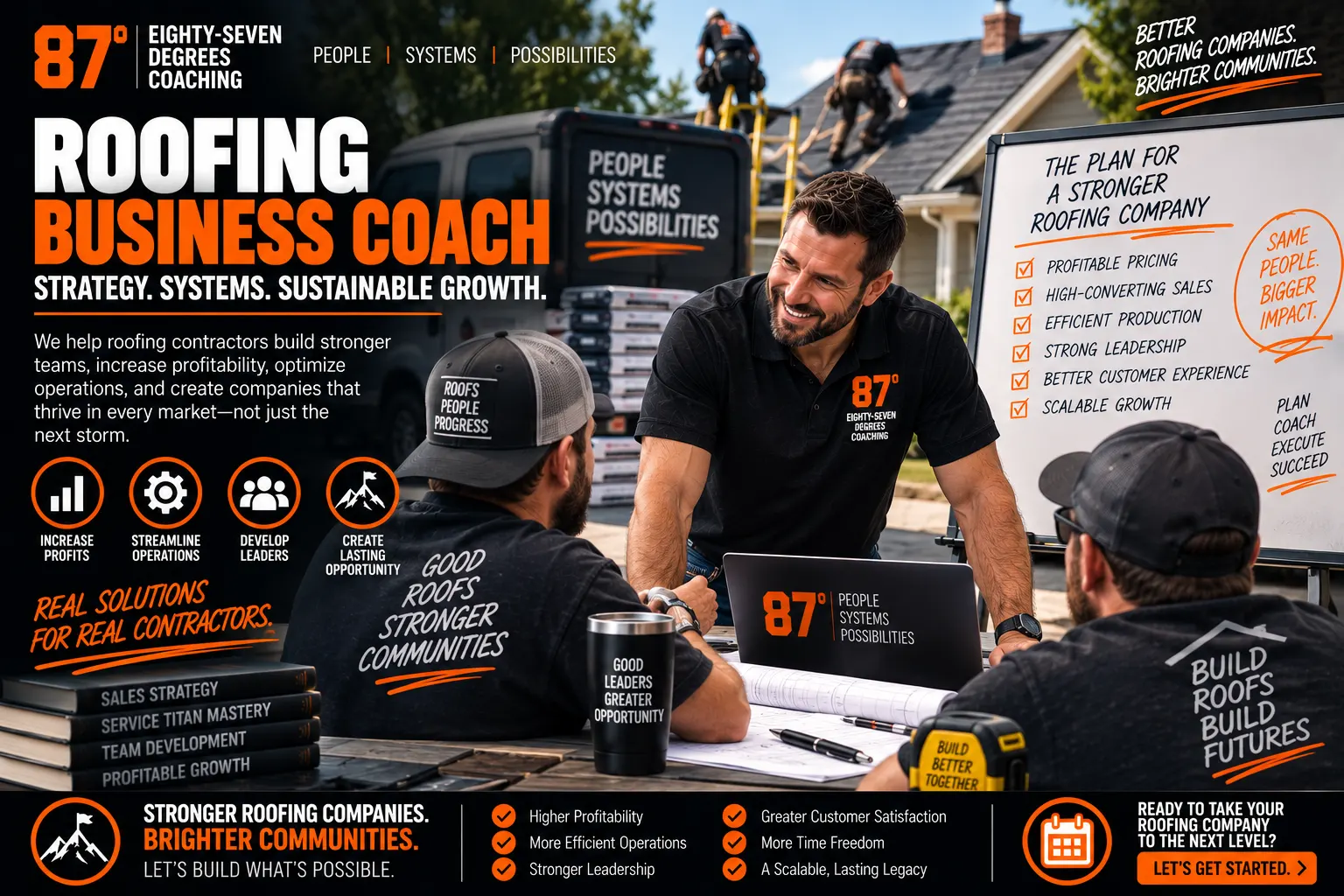
A roofing business coach helps owners build the systems, leadership, sales processes, financial visibility, and accountability needed to create sustainable growth in any market.
At Eighty-Seven Degrees Coaching, we help contractors build companies designed to perform consistently rather than depending on the next storm, salesperson, or surge in demand.
Your Roofing Company Needs to Work in Every Season
Storm-driven growth can hide weaknesses.
When demand is overwhelming, almost everything looks successful.
Salespeople close deals.
Crews stay busy.
Revenue increases.
Marketing appears effective.
But what happens when demand normalizes?
That’s when the quality of the business becomes visible.
A strong roofing company should have systems capable of generating and converting opportunities even when customers aren’t lining up after a major weather event.
That requires building a business instead of simply reacting to the market.
What Does a Roofing Business Coach Do?
A roofing business coach helps ownership step outside the daily activity of selling and producing roofs to evaluate how the company itself operates.
That can include:
- Sales performance
- Lead management
- Pricing
- Gross margins
- Production
- Crew efficiency
- Marketing
- KPIs
- Leadership
- Recruiting
- Customer experience
- Technology
- Cash flow
- Growth strategy
The goal isn’t generic motivation.
It’s identifying the specific systems preventing the company from reaching its next level and developing a plan to improve them.
Revenue Isn’t the Same as Profit
Roofing companies can produce impressive revenue numbers while struggling financially.
A $10 million roofing company isn’t automatically healthier than a $5 million roofing company.
What matters is what remains after:
- Materials
- Labor
- Sales commissions
- Marketing
- Vehicles
- Insurance
- Office payroll
- Software
- Warranty expenses
- Overhead
If revenue grows while margins shrink, the company may actually become more financially vulnerable as it gets larger.
A roofing business coach helps leadership look beyond top-line revenue.
Know Your Gross Margin on Every Job
Pricing shouldn’t begin with:
“What are the other roofers charging?”
Your competitors don’t have your expenses.
Your pricing needs to support your company’s economics.
That means understanding:
Selling Price – Direct Job Costs = Gross Profit
Then calculate:
Gross Profit ÷ Selling Price = Gross Margin
Leadership should know what gross margin the company needs to support overhead and produce a healthy net profit.
Without that number, pricing becomes guesswork.
Job Costing Should Confirm Your Estimates
You estimated a roofing project at a 40% gross margin.
Great.
What did it actually produce?
Compare estimated versus actual costs for:
- Materials
- Labor
- Dump fees
- Permits
- Equipment
- Subcontractors
- Other direct costs
If jobs consistently finish below estimated margins, investigate why.
The problem might be pricing.
Or estimating.
Or material waste.
Or production.
The number tells you where to start looking.
Small Material Errors Become Big Money
Consider a roofing company completing hundreds of projects annually.
A few hundred dollars of unnecessary material expense on one job may not seem catastrophic.
Multiply it across 500 roofs.
Now it matters.
Track:
- Material ordered
- Material used
- Returns
- Waste
- Supplemental purchases
Improving material management by even a small percentage can create meaningful additional profit.
Your Sales Team Needs a Process
Some roofing companies build their entire sales operation around individual personalities.
One salesperson has their own pitch.
Another has a completely different presentation.
Another barely follows up.
One enters everything into the CRM.
Another keeps customer information in their phone.
That isn’t a sales system.
That’s a collection of independent salespeople.
A scalable roofing business needs a repeatable process.
Build the Roofing Sales Journey
A defined sales process might include:
- Lead received
- Initial contact
- Appointment scheduled
- Property inspection
- Customer discovery
- Findings presented
- Solutions discussed
- Estimate delivered
- Financing discussed when appropriate
- Follow-up
- Contract signed
- Production handoff
Each stage should have a clear expectation.
Then measure conversion between stages.
Track Lead-to-Sale Conversion
Imagine generating 1,000 roofing leads.
If 60% become appointments:
600 appointments
If 70% receive proposals:
420 proposals
If 35% close:
147 customers
Instead of simply saying, “We need more leads,” identify where opportunities are being lost.
Maybe lead volume is fine.
Maybe the biggest opportunity is improving appointment conversion.
Or follow-up.
Or closing.
Better data helps you improve the right problem.
Sales Coaching Should Go Beyond Closing Techniques
Roofing salespeople need more than a clever script.
Effective sales coaching can address:
- Discovery
- Inspection presentation
- Customer communication
- Value
- Financing
- Objections
- Follow-up
- Referral generation
- CRM usage
- Accountability
Great salespeople don’t simply talk well.
They follow a repeatable process consistently.
Your CRM Should Know More Than Your Salesperson’s Memory
Ask your sales manager:
How many open roofing opportunities do we have right now?
Then ask:
How many haven’t been contacted in the last seven days?
If those questions are difficult to answer, your CRM process may need attention.
Every opportunity should have:
- Current stage
- Responsible salesperson
- Last contact
- Next action
- Estimate value
- Relevant notes
If the information only exists inside a salesperson’s head, the company doesn’t truly own the opportunity.
Speed-to-Lead Matters
Roofing leads can be extremely competitive.
A homeowner may submit multiple inquiries within minutes.
Your company should have a defined process for new opportunities.
Track:
- Response time
- Contact rate
- Appointment rate
- Source
- Salesperson
The faster your team consistently engages qualified leads, the less opportunity competitors have to control the conversation first.
Stop Letting Estimates Die
How much money is currently sitting in unsold roofing estimates?
It could be substantial.
A homeowner who doesn’t immediately sign isn’t necessarily lost.
They may:
- Need another estimate
- Want to discuss financing
- Be waiting for insurance information
- Need to speak with a spouse
- Have questions
- Simply need more time
Build a structured follow-up process.
Don’t rely on salespeople remembering.
Every Lead Source Should Be Connected to Revenue
Marketing reports often focus on:
- Clicks
- Impressions
- Leads
- Cost per lead
Those metrics are useful.
But roofing owners ultimately need to know:
Which marketing generated profitable jobs?
Connect:
Marketing Spend → Lead → Appointment → Estimate → Sale → Revenue
A campaign producing $40 leads isn’t automatically better than one producing $100 leads.
The second campaign may produce substantially better customers.
Referrals Should Be a System
Roofing naturally creates opportunities for referrals.
Your work is visible.
Neighbors see the trucks.
Homeowners talk.
Yet many companies simply hope referrals happen.
Create a process for requesting them.
The best time might be after:
- Successful installation
- Positive customer feedback
- Final walkthrough
- Positive review
Don’t make referrals an accident.
Reviews Are Part of Your Sales Infrastructure
Before inviting a roofing contractor to their home, customers often research the company.
Your reviews can influence whether the lead ever contacts you.
Build review generation into the customer journey.
Monitor:
- Review volume
- Average rating
- Recent reviews
- Response process
Customer experience and marketing are increasingly connected.
Production Is Where Sales Promises Become Reality
Sales can generate the revenue.
Production determines whether the company delivers what was promised profitably.
The handoff between sales and production should be extremely clear.
Production needs accurate information about:
- Scope
- Materials
- Color
- Customer expectations
- Property details
- Special conditions
- Permits
- Scheduling commitments
- Contract details
Incomplete handoffs create expensive surprises.
Create a Pre-Production Checklist
Before scheduling a roofing project, confirm everything required to complete it.
A checklist may include:
- Contract complete
- Financing approved
- Insurance documentation complete when applicable
- Measurements verified
- Materials confirmed
- Crew scheduled
- Permits obtained
- Customer notified
A simple checklist can prevent major operational problems.
Measure Crew Performance
Your crews should have KPIs too.
Depending on your business model, monitor:
- Jobs completed
- Labor cost
- Production time
- Material variance
- Callbacks
- Warranty issues
- Customer satisfaction
Look for patterns.
One crew may consistently finish faster but produce more callbacks.
Another may have significantly lower material waste.
The data creates coaching opportunities.
Callbacks and Warranty Work Are Profit Leaks
Every time you send someone back to correct a previous roofing project, the company absorbs additional cost.
That can include:
- Labor
- Materials
- Vehicle expenses
- Administrative time
- Opportunity cost
Track warranty and callback issues by:
- Crew
- Job type
- Cause
- Cost
Then conduct root-cause analysis.
Don’t simply fix the roof.
Fix the process that allowed the issue to happen.
Build a Roofing KPI Scoreboard
Leadership doesn’t need hundreds of numbers.
Start with metrics that answer important questions.
Sales KPIs
- Leads
- Appointments
- Estimates
- Close rate
- Average sale
- Revenue per lead
Production KPIs
- Jobs completed
- Cycle time
- Material variance
- Labor cost
- Callbacks
Financial KPIs
- Revenue
- Gross margin
- Net profit
- Accounts receivable
- Cash position
Marketing KPIs
- Cost per lead
- Cost per appointment
- Customer acquisition cost
- Revenue by source
Give each manager a scoreboard they can influence.
Stop Managing Only From the Bank Account
Checking the company’s bank balance is not financial management.
Cash is important, but it doesn’t tell you the complete story.
A large balance today might need to fund:
- Upcoming payroll
- Material invoices
- Taxes
- Commissions
- Insurance
- Debt
- Future production
Leadership needs financial reporting that provides a clearer picture of performance.
Cash Flow Matters Tremendously in Roofing
Roofing companies can encounter significant timing differences between expenses and revenue.
Materials may need to be purchased before payment is received.
Payroll continues regardless.
Insurance-related work may involve additional timing considerations.
Fast growth can actually increase cash pressure.
A roofing business coach can help ownership think more intentionally about budgeting, forecasting, and financial planning.
Know Your Break-Even Point
How much revenue does your roofing company need every month just to cover expenses?
Leadership should know.
Understanding your break-even point helps with:
- Revenue targets
- Staffing
- Marketing budgets
- Pricing
- Growth decisions
Once you understand the minimum, you can establish targets that actually produce the desired profit.
Stop Promoting Great Salespeople Into Management Without Training
Your best salesperson gets promoted to sales manager.
Now they’re responsible for:
- Coaching
- Accountability
- Pipeline management
- Recruiting
- Performance conversations
- Forecasting
Those are different skills.
The same applies to production managers.
Managers need leadership development.
A roofing business coach can help develop the people responsible for developing everyone else.
Managers Need Authority
If managers need the owner’s approval for every decision, the owner remains the bottleneck.
Define authority around:
- Discounts
- Customer resolutions
- Scheduling
- Purchases
- Employee issues
Then hold managers accountable for the results within their responsibility.
Delegation requires both responsibility and authority.
Build a Weekly Roofing Leadership Meeting
Meetings should drive action.
A useful weekly structure might include:
Review the Scoreboard
Where are we compared with target?
Review the Pipeline
What revenue is expected?
Review Production
What’s being installed?
What’s delayed?
Identify Problems
Where are we off track?
Assign Actions
Who is doing what by when?
The goal isn’t to spend two hours talking.
It’s to leave with clarity.
Stop Solving the Same Problems Every Week
If the same issue keeps appearing in leadership meetings, stop treating it as an isolated event.
Ask:
What process is missing?
If sales repeatedly sends incomplete jobs to production, build a handoff checklist.
If crews repeatedly lack materials, improve job preparation.
If customers repeatedly ask the same questions, improve communication.
Recurring problems usually deserve systemic solutions.
Document Your Core Processes
A roofing business preparing to scale should document critical workflows.
Start with:
- Lead handling
- Sales process
- Estimating
- Production handoff
- Material ordering
- Scheduling
- Installation
- Quality control
- Payment collection
- Warranty claims
Keep procedures practical.
A one-page checklist employees actually use is better than a 30-page manual nobody reads.
Technology Should Make the Business Easier to Manage
Home service technology such as ServiceTitan can help contractors create stronger visibility and more consistent processes when it fits their operation and is configured appropriately.
Technology should help leadership understand:
- Where opportunities stand
- Who owns them
- What work is scheduled
- How teams are performing
- What needs attention
Software should reduce administrative friction rather than create another place employees have to enter the same information.
Build the Business Around Accountability
Accountability shouldn’t mean employees are constantly afraid of making mistakes.
It means expectations are clear.
Every key role should understand:
What am I responsible for?
How is success measured?
What decisions can I make?
Who do I report to?
What happens when performance misses target?
Clarity makes accountability much easier.
Recruiting Cannot Be an Emergency Activity
Roofing companies often recruit when they suddenly need people.
That’s usually the worst time.
Build an ongoing recruiting pipeline for:
- Salespeople
- Production staff
- Office employees
- Managers
- Crew relationships
Your growth plan is only realistic if your people strategy can support it.
Don’t Let One Superstar Control Your Revenue
If one salesperson produces 40% of your company’s sales, that’s impressive.
It’s also a risk.
Study what that person does well.
Turn it into:
- Training
- Scripts
- Processes
- Follow-up standards
- Coaching
Your objective should be to raise the performance of the entire sales team.
The company should own the system.
Build a Company That Doesn’t Depend on the Owner
Here’s one of the most important questions a roofing owner can ask:
What happens if I disappear for 30 days?
Would:
- Sales continue?
- Production stay on schedule?
- Managers make decisions?
- Financial reports get reviewed?
- Customer problems get resolved?
- Marketing continue?
- Hiring continue?
Whatever breaks identifies where owner dependency still exists.
Growth Should Give the Owner More Leverage
If your roofing company doubles in revenue but your working hours also double, you’ve built a larger job for yourself.
Scalable growth should gradually create leverage through:
- Management
- Processes
- Technology
- Reporting
- Accountability
The owner should become increasingly focused on strategy rather than daily firefighting.
Be Careful About Expanding Too Early
A new market can be exciting.
But a second location can duplicate your existing problems.
Before expansion, ask:
- Is the current operation consistently profitable?
- Are sales processes repeatable?
- Is production reliable?
- Do managers perform without constant owner intervention?
- Are KPIs accurate?
- Is recruiting repeatable?
If not, strengthen the existing company before duplicating it.
Roofing Business Coach vs. Roofing Consultant
The roles often overlap, but there’s a useful distinction.
Roofing Business Consulting
Consulting tends to focus on analyzing the company, identifying problems, and developing solutions.
Roofing Business Coaching
Coaching focuses heavily on implementation, accountability, leadership development, and sustained improvement.
Many contractors benefit from both.
Knowing what to do is valuable.
Actually getting the organization to do it consistently is where results happen.
When Should You Hire a Roofing Business Coach?
Consider coaching when:
- Revenue has plateaued
- Margins are inconsistent
- Salespeople lack accountability
- Production problems are increasing
- The owner is overwhelmed
- Managers need development
- KPIs aren’t clear
- Marketing performance is difficult to measure
- Growth feels increasingly chaotic
- You’re preparing to expand
Business coaching doesn’t need to be a rescue mission.
It can be a way to strengthen a successful company before the next stage of growth.
Why Choose Eighty-Seven Degrees Coaching?
Eighty-Seven Degrees Coaching works with contractors and home service businesses to create stronger companies through better systems, people, numbers, and execution.
Areas of focus include:
- Roofing business coaching
- Contractor business consulting
- Sales coaching
- Leadership development
- KPI development
- Operational consulting
- Pricing strategy
- Technology optimization
- Budget development
- Growth planning
The objective is not to force every roofing company into the same model.
It’s to understand where your business is today, identify what’s limiting its performance, and create a practical roadmap for where you want to take it.
Build a Roofing Company That Doesn’t Need a Storm to Grow
Storms will come and go.
Markets will change.
Lead costs will change.
Competitors will enter and exit.
A strong roofing company cannot control all of those things.
It can control how well the business operates.
Strong leadership.
Disciplined sales.
Profitable pricing.
Reliable production.
Useful KPIs.
Consistent accountability.
Those are the systems that make growth more predictable.
An experienced roofing business coach can help you move beyond simply chasing the next job and start building a company designed to perform year after year.
If you’re ready to create a more profitable, scalable, and professionally managed roofing company, contact Eighty-Seven Degrees Coaching and start building the systems behind sustainable growth.