
You wouldn’t send a technician into the field without giving them an opportunity to learn the equipment they’re expected to service.
So why send a Comfort Consultant into a homeowner’s living room without practicing the conversations they’re expected to navigate?
Every appointment is different.
Some homeowners are worried about price. Others don’t understand why their system needs to be replaced. Some have three competing estimates sitting on the kitchen table. Others are ready to buy but aren’t sure which system makes sense.
Role play gives Comfort Consultants an opportunity to experience those situations before they happen with a real customer.
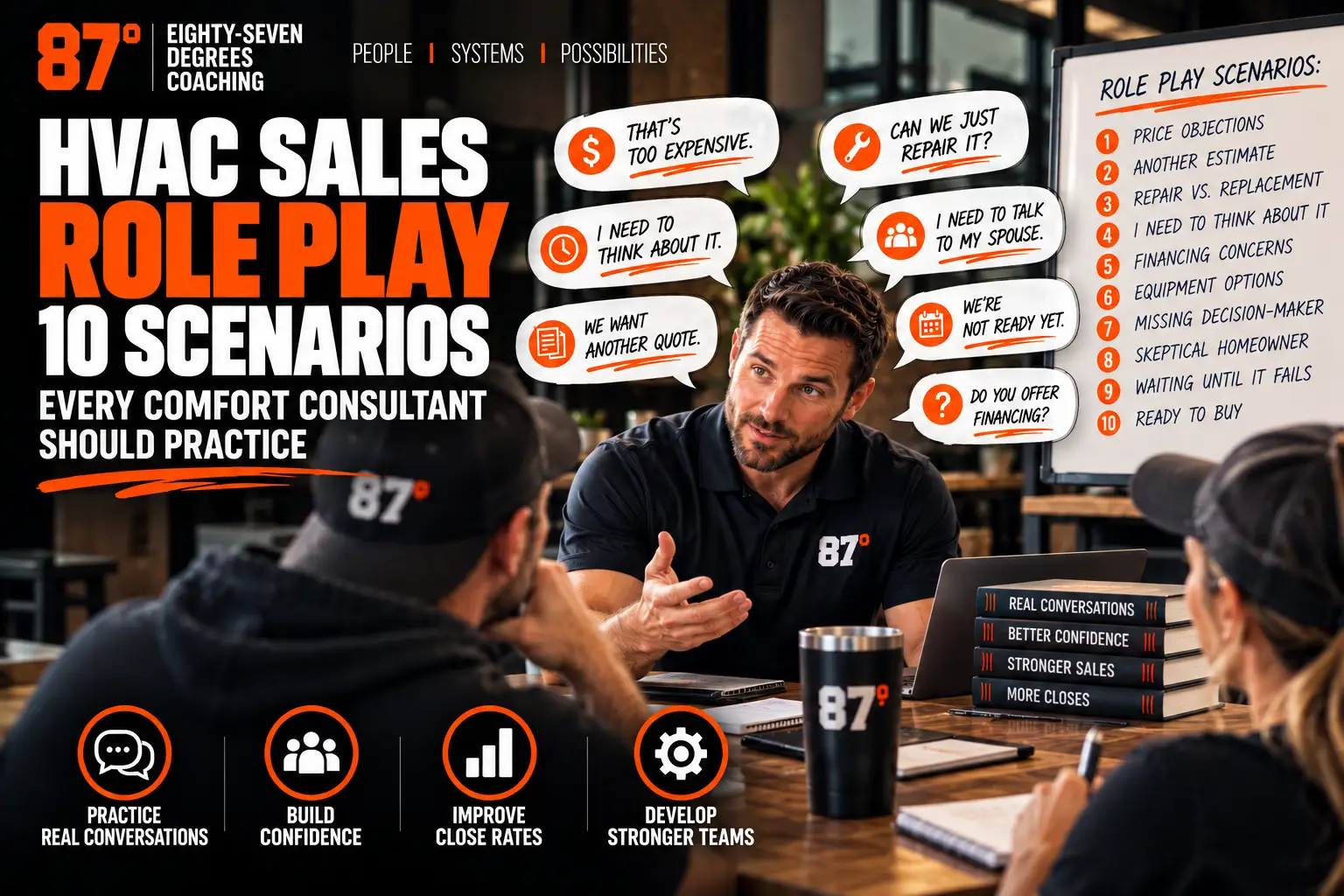
Here are 10 scenarios worth incorporating into your HVAC sales coaching.
1. The Homeowner Who Only Wants a Price
Scenario: The Comfort Consultant arrives and the homeowner immediately says:
“I don’t need the whole presentation. Just tell me how much a new system costs.”
The consultant needs to resist the temptation to immediately start quoting equipment.
Instead, practice explaining why understanding the home, existing system, and homeowner’s priorities is necessary before recommending a solution.
Coaching focus: Establishing value before discussing price.
2. The Homeowner With a Cheaper Estimate
Scenario: Another contractor’s proposal is $2,500 less.
Have the Comfort Consultant practice asking questions about the competing proposal without criticizing the other company.
Are the systems comparable?
Is the scope of work the same?
What warranties are included?
What did each contractor evaluate?
Coaching focus: Communicating differences without attacking competitors.
3. The Homeowner Who Wants Another Repair
Scenario: The system is older and has required multiple repairs, but the homeowner wants to repair it again.
The consultant should be able to discuss the homeowner’s options without making the conversation feel like an ultimatum.
Practice explaining the factors worth considering when comparing another repair with replacement.
Coaching focus: Helping customers evaluate options rather than pushing a predetermined outcome.
4. The Homeowner Who Says, “I Need to Think About It”
This phrase can mean almost anything.
Price.
Timing.
Trust.
Another estimate.
Another decision-maker.
Or genuinely needing more time.
Have the Comfort Consultant practice respectfully uncovering what the homeowner still needs to evaluate.
Coaching focus: Asking questions instead of immediately responding with another sales pitch.
5. The Homeowner Concerned About Monthly Payments
Scenario: The homeowner likes the proposed solution but isn’t comfortable with the upfront investment.
Practice transitioning naturally into available financing options without making assumptions about the homeowner’s financial situation.
The Comfort Consultant should be able to clearly explain the options the company provides and answer basic questions about the process.
Coaching focus: Discussing financing professionally and comfortably.
6. The Homeowner Who Doesn’t Understand the Equipment Options
Scenario: You’ve presented several systems and the homeowner says:
“I don’t really understand the difference between these.”
That’s a communication problem, not a customer problem.
Have the Comfort Consultant practice explaining the differences in plain language, focusing on the homeowner’s priorities rather than drowning them in specifications.
Coaching focus: Making complex HVAC information easy to understand.
7. The Missing Decision-Maker
Scenario: One spouse is home. The other wants to be involved before making a decision.
What happens next?
Practice summarizing the recommendations clearly and establishing a specific follow-up plan.
You can also role play bringing the other decision-maker into the conversation by phone or video when appropriate.
Coaching focus: Creating a next step instead of leaving the appointment open-ended.
8. The Homeowner Who Doesn’t Trust Salespeople
This one is important.
The homeowner has already had several contractors in the house and is skeptical of everyone.
They question recommendations.
They challenge pricing.
They assume they’re being sold something they don’t need.
The worst response is becoming defensive.
Practice slowing the conversation down, asking questions, explaining the evaluation, and giving the homeowner room to make their own decision.
Coaching focus: Building trust through transparency.
9. The Homeowner Who Wants to Wait Until the System Dies
Scenario: The existing equipment is still operating, so the homeowner sees no reason to replace it yet.
Instead of creating artificial urgency, practice discussing the advantages and disadvantages of waiting.
What happens if the system fails during extreme weather?
Could availability become an issue?
What options does the homeowner have today?
Then let the homeowner decide.
Coaching focus: Explaining consequences without using scare tactics.
10. The Homeowner Who Is Ready to Buy
Not every role-play scenario needs to involve an objection.
Sometimes the customer says yes.
Your Comfort Consultant still needs to know what happens next.
Practice reviewing the selected solution, confirming expectations, explaining installation scheduling, discussing paperwork, and making sure the homeowner knows what to expect.
A great sales process shouldn’t suddenly become sloppy after the customer agrees to move forward.
Coaching focus: Creating a professional handoff from sale to installation.
How to Run an Effective HVAC Sales Role-Play Session
Don’t simply hand your team these scenarios and tell them to practice.
Assign roles.
One person is the Comfort Consultant. Another plays the homeowner. A manager or teammate observes.
Give the “homeowner” information the salesperson doesn’t initially know.
For example:
Homeowner: You’re concerned about price, but your real concern is that you’re planning to move in three years.
Now the Comfort Consultant has to discover the underlying concern through conversation.
Afterward, discuss what happened.
What questions worked?
Where did the conversation become uncomfortable?
Was something left unexplained?
What could the consultant try differently?
Then run the scenario again.
Don’t Practice Until You Get It Right
Practice until the conversation becomes comfortable.
There’s an important difference.
The objective of role play isn’t to teach Comfort Consultants a collection of canned responses.
Real homeowners don’t follow scripts.
Instead, role play should help your team become comfortable listening, asking better questions, explaining options, and navigating unexpected conversations.
That’s what makes the exercise valuable.
Make Role Play Part of Your Sales Culture
One role-play session isn’t sales training.
Consistency matters.
Choose one or two scenarios during a weekly sales meeting. Change the details. Rotate participants. Incorporate situations your Comfort Consultants actually encountered during the previous week.
Over time, your team builds experience without having to learn every lesson during a live customer appointment.
That’s also the philosophy behind the Comfort Consultant Program™ from Eighty-Seven Degrees. The six-week, manager-led system incorporates role play alongside weekly coaching, real-world assignments, objection frameworks, home evaluation worksheets, and a defined in-home sales process.
The goal isn’t to teach Comfort Consultants what to say word-for-word.
It’s to give managers a repeatable way to teach, practice, reinforce, and coach better customer conversations.